Introduction
For my software engineering module assignment, my team built Eventure, a mobile-first web platform for event discovery. The project was part of a Smart Nation-themed assignment, where teams were challenged to build an application utilising APIs that pulled real-world data and was able to demonstrate that it delivered clear value to intended users, rather than simply displaying that information on a flat screen. The project was assessed not only on the final prototype, but also on the quality of the team’s process and deliverables throughout the course of the semester.
What stood out to me about this module was that it kind of pushed us straight into the deep end. We were expected to figure out how to design and build a full-stack application while simultaneously learning how to work through the full software development lifecycle (SDLC). That meant moving from requirements elicitation and analysis into design, implementation, testing, documentation, and finally a live demo. Fortunately, I came into the project with some prior experience from polytechnic, so I was able to approach that learning curve with a bit more confidence, and help guide and lead development within the team.
In this post, I just want to share what my team and I had worked on and more importantly, detail what I had learnt in the process.
What is Eventure?
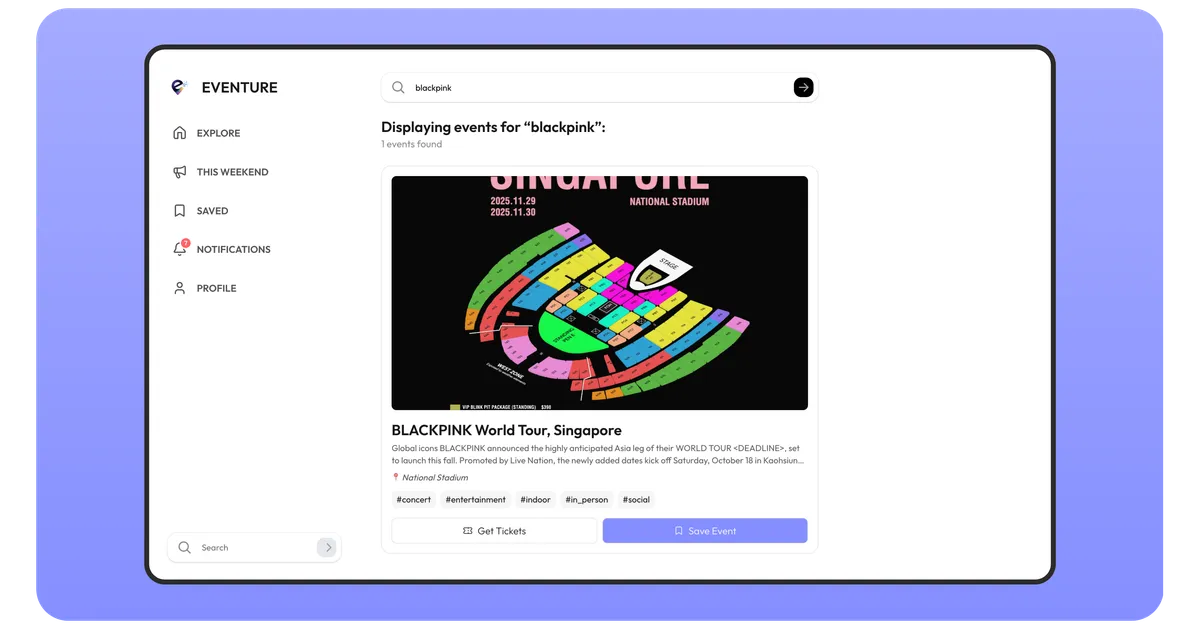
We eventually landed on the idea of an event discovery platform.
What made this idea caught on for us was that event discovery already exists, but often in a form that feels static, cluttered or overly text-heavy. Users can find events through services like Google Search and ticketing platforms, but the experience can feel overwhelming and not exactly engaging. Eventure was our attempt at reimagining that experience and make discovering events feel more intuitive, interactive, approachable and most importantly, fun.
That was where the idea of the swipe-based interaction came in. Instead of asking users to scroll through boring text-heavy event listings, we wanted them to move through events quickly, react to them naturally, and only have them spend time on events that actually interested them. It gave the project a clearer product identity and helped us move beyond the ideation phase.
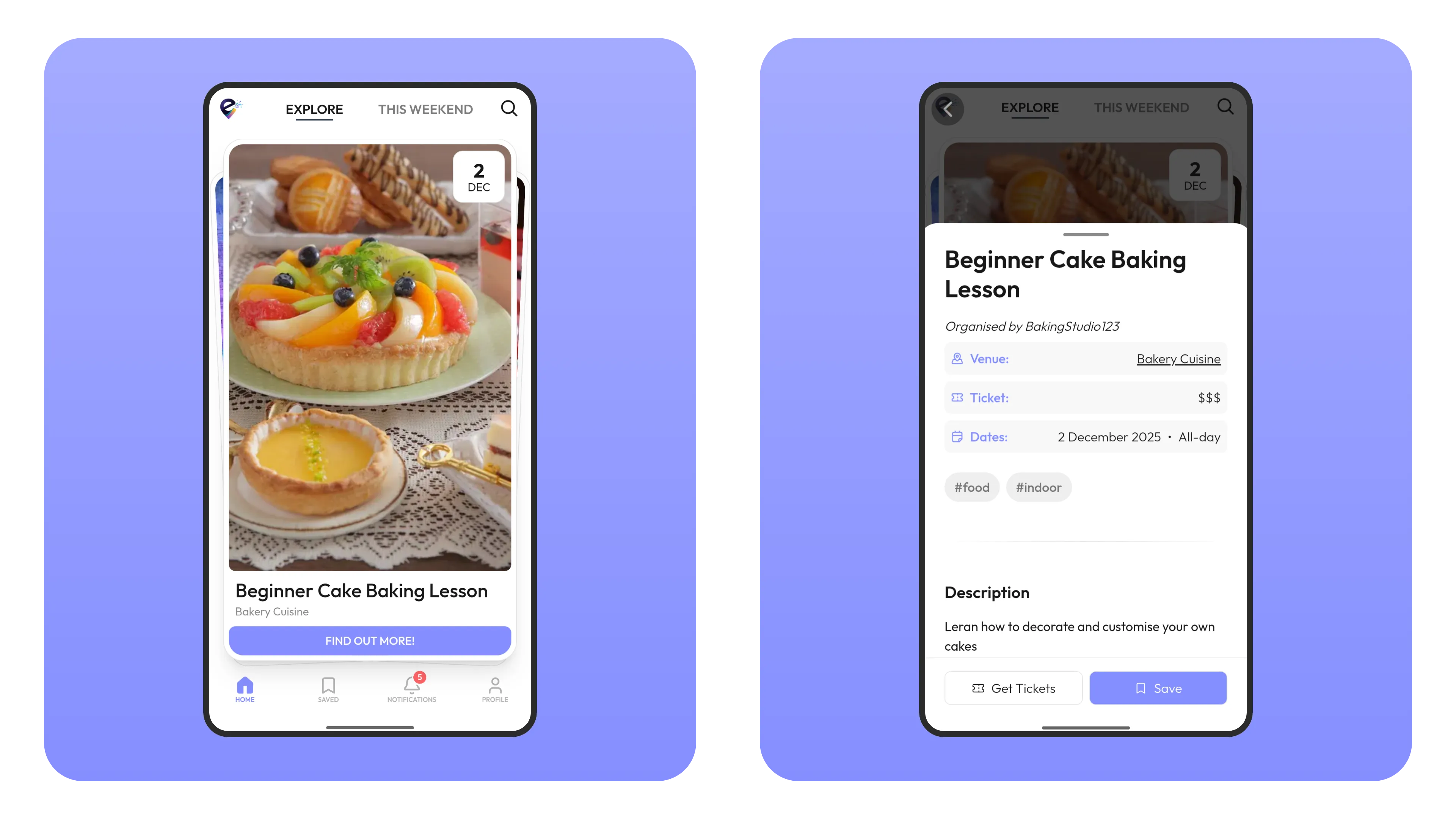
At the same time, we also wanted the platform to be useful not just for attendees, but for smaller organisers as well, as part of the Smart Nation initiative. So that Eventure would be multi-layered and more than just an discovery feed. Therefore, we included an organiser side where event organisers could submit and manage events, and an admin side where those submissions could be reviewed and moderated before being published to users.
How we designed Eventure and why we built it that way
Overview of our system
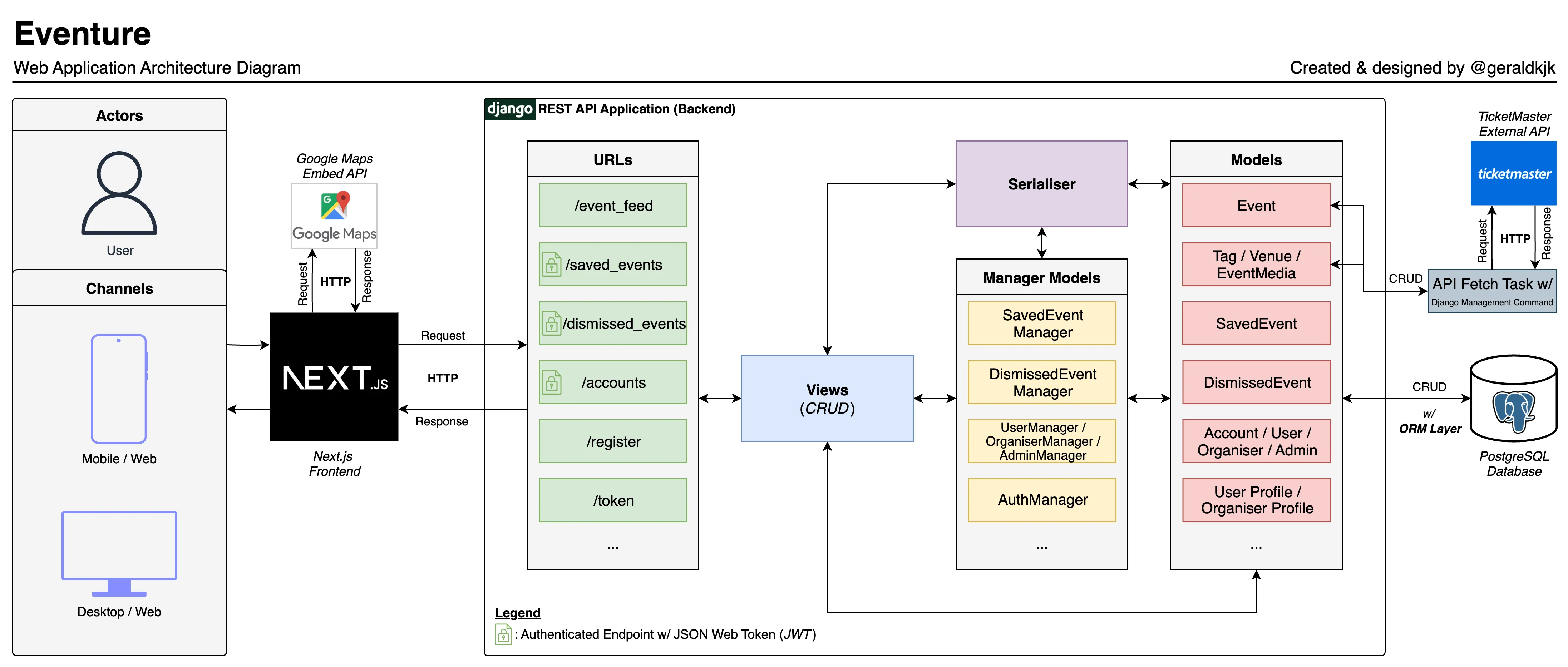
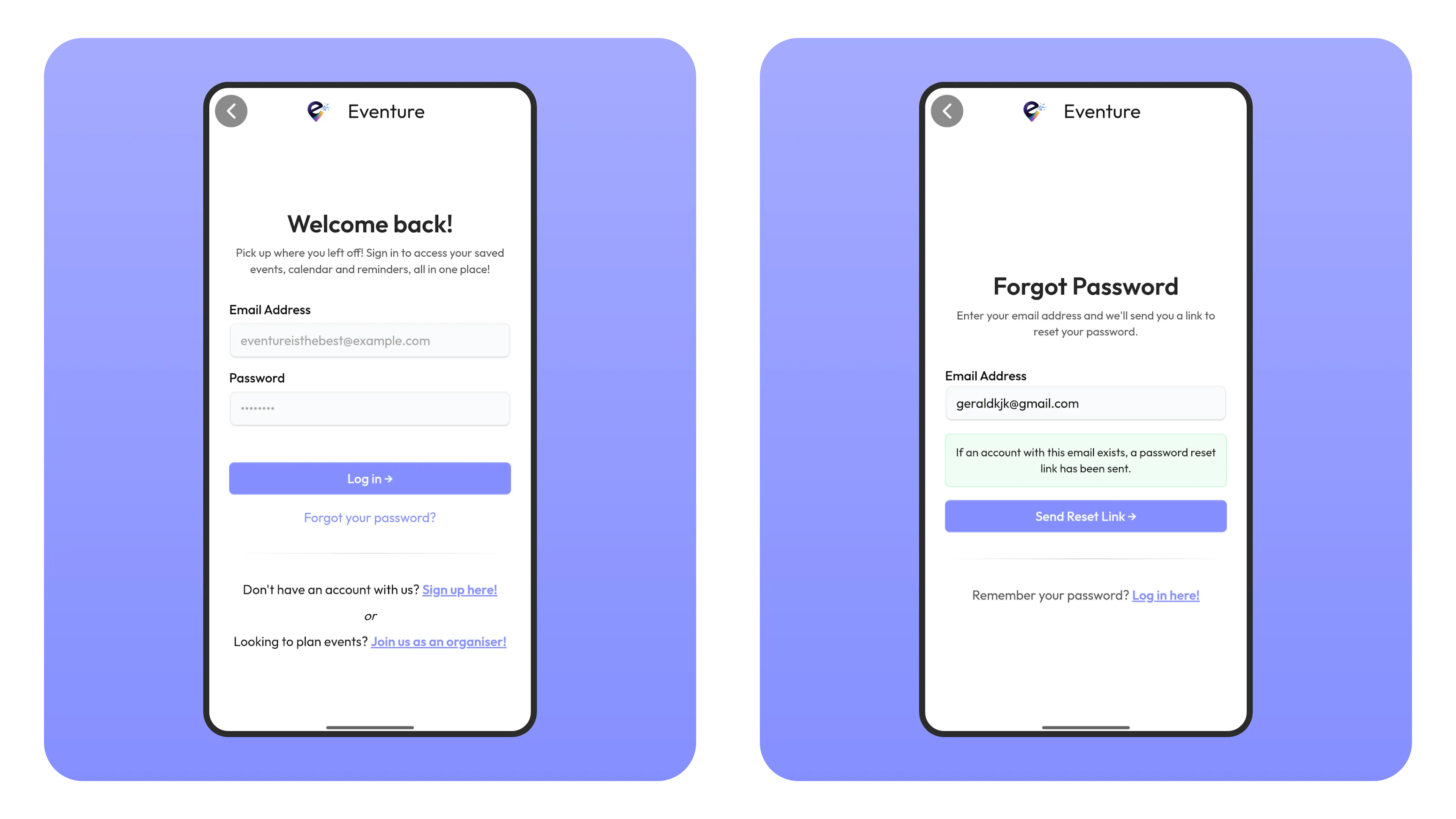
At a high level, Eventure was designed as a decoupled client-server application. The frontend was built with Next.js, TypeScript, and Tailwind CSS, while the backend was built using Django REST Framework and PostgreSQL. We also integrated external services such as the Ticketmaster Discovery API for real-world event data, Google Maps for venue-related navigation, and Gmail SMTP for email verification and password reset user flows.
The reason we went with this structure was fairly straightforward, we wanted clear separation between presentation and business logic. The frontend could focus on presentation and user interaction, while the backend handled the authentication, event management, data persistence, and external API integration. Once those boundaries were clearer, the project became easier to reason about and much easier to split across the team. It also made the architecture feel closer to how production web applications are typically structured, rather than everything being tightly coupled in one place.
Looking back, I think this part of the project was one of the most meaningful and fun for me. It was one thing to build features, but another to think clearly about why the system should be structured a certain way.
Even though some may say that this was “just a school project”, I honestly do not think that means system design decisions should be treated casually. If anything, projects like this provide the sandbox and opportunity to play around with such ideas and technologies, and practice thinking through trade-offs in a low-risk manner.
Our tech stack and why
When it came to the stack itself, our choices were shaped less by what was theoretically the best fit, and more so of what was approachable and practical for the kind of product we were trying to build. Besides, we also wanted to take this opportunity to pick up modern frameworks and tools that may be in higher demand currently or simply out of pure interest.
Frontend
As Eventure was meant to feel interactive, responsive, and boasts a mobile-first experience, we wanted a frontend stack that would let us build quickly while still keeping the codebase organised. Next.js gave us that balance. Its built-in file-based routing and clearer project structure made it easier to keep the frontend organised and helped accelerate our development progress, especially as we were constantly iterating on the user experience.
Using TypeScript also helped ease the development of the frontend, especially once the number of components, pages, and API interactions started growing. It reduced some of the guessing we had to do around data types, and state handling, which was useful in a project where several people were touching different parts of the frontend.
As for Tailwind CSS, it was simply a very practical choice. We were making frequent UI adjustments, and Tailwind made that process much faster. It let us prototype and tweak the interface without spending too much time jumping between various files or overthinking styling.
We also used TanStack Query to manage server state for the infinite event feed. That was especially helpful for handling data fetching more cleanly and keeping the browsing experience smoother as users swiped through events.
Backend
We chose Django REST Framework to power our backend because it gave us a lot of useful functionality out of the box, as a batteries-included framework. Authentication, API development, serialisers, and admin tooling were things we benefitted from fairly early on, and Django let us get those foundations in place without having to build everything from scratch, effectively speeding up our development. That mattered a lot in a semester-long(or -short) project where time was limited and we had to balance actual development with documentation and other deliverables, ON TOP of managing other academic commitments as well.
PostgreSQL was a natural fit as the relational database since the data model involved users, organisers, admins, events, and interactions between them, and we wanted something dependable and structured. It also had the best compatibility and support with Django, making it the go-to choice for us.
We also exposed interactive API documentation through Swagger/OpenAPI, which made it much easier to test endpoints and understand how the system was evolving during API development. Another very practical benefit of using Django was the built-in admin panel, which gave the team a much more convenient way to inspect and manage data without constantly needing to work directly through the CLI or pgAdmin.
Containerisation
I also took this project as an opportunity to work with Docker for containerising the services via Docker Compose.
Having a containerised setup helped reduce environment-related friction across the team and made it easier for everyone to run the project more consistently. It also reinforced something I had already started appreciating from past experience during polytechnic which is that a smooth development setup can have a very real impact on how well a team works. It may not be the most visible part of a project, but when the setup is cleaner, collaboration becomes much less frustrating.
Challenges we faced
One of the biggest challenges was not building the application, but coming up with the formal software engineering documents itself.
This module was not only asking us to build a working application, but also to produce a long chain of deliverables across the SDLC: requirements, use case models, class diagrams, sequence diagrams, dialog maps, system architecture, application skeleton, testing artefacts, demo preparation, and final documentation. That meant the project was never just “build the app”. It was also about continuously translating what we were building into formal software engineering artefacts at each stage.
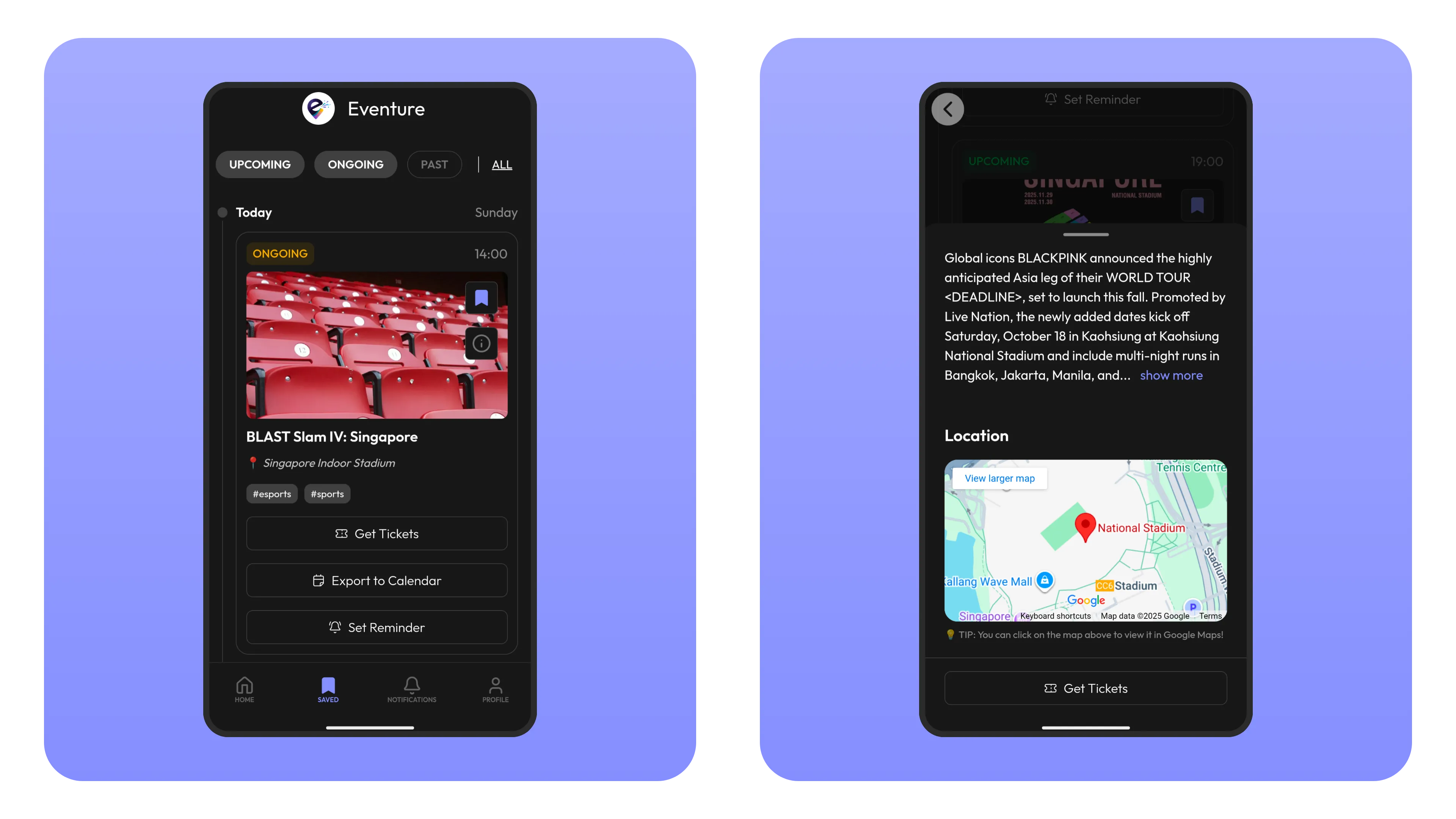
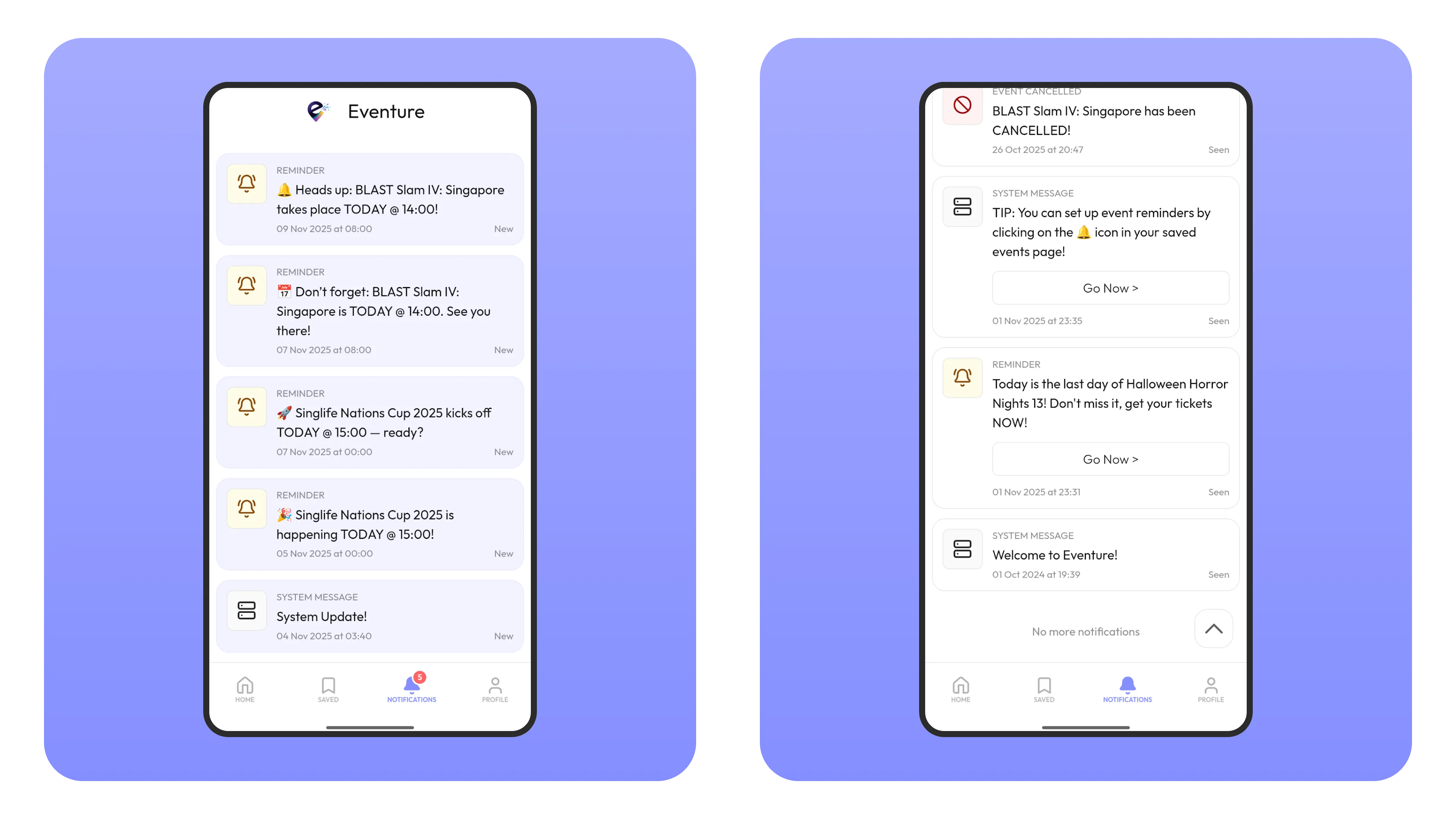
Another challenge was keeping the project manage-able in scope. Eventure had not just one user flow. It involved regular users, organisers, and admins, each with their own feature sets. On the user side alone, there was registration, login, profile management, event browsing, saved events, notifications, search, and calendar export. On top of that, we also had organiser event creation and updating, as well as admin approval flows. Once you put all of that together, the project becomes quite a bit larger than it first sounds.
On the team side, I also found task delegation harder than I initially expected. It was not just about assigning work evenly, but about balancing different things at once:
- what each person was comfortable with,
- what they wanted to learn,
- what the project urgently needed,
- and how interdependent certain tasks were (and whether it would overlap another’s work).
In practice, this took a lot more coordination and communication, especially when the project is moving quickly due to the tight timeline and we were learning as we go.
What I learnt from the project
Looking back, one of the biggest things this project taught me was that software engineering is rarely just about writing code. A lot of the real work happens before and around implementation.
One lesson that stood out to me was how quickly even a relatively small product can become complex. On paper, Eventure sounded fairly straightforward, an event discovery platform. But once multiple user groups, external API integrations, documentation requirements, and team coordination entered the picture, the project became far more layered and complex than it first appeared. What made the difference was not just whether we could implement features, but whether we could organise the system clearly, separate responsibilities properly, and make decisions that kept development sustainable over time.
That changed how I think about engineering work. A good system is not just one that works, but one that remains understandable to the people building and maintaining it. In that sense, software engineering is often about reducing complexity just as much as it is about delivering functionality.
On a more personal level, this project also helped confirm the kind of work I find most engaging.
I enjoyed building features, but what I found especially meaningful was thinking about how the system should come together as a whole. I liked considering how different components should interact, how responsibilities should be divided, how the design should support future growth, and how those decisions could be communicated clearly to others. That broader system-level view was something I found myself naturally drawn to throughout the project.
I think that is what made Eventure stand out to me. It did not just strengthen my technical skills, it also gave me a clearer sense of the kind of engineering problems I enjoy solving.
What I would improve if I continued it
If I were to continue working on Eventure, here is a quick list of features I would add/improve:
- Event recommendation. One of the first things would be the discovery experience itself. The swipe-based idea gave the platform a strong identity, but I think there is still a lot of room to make the browsing experience more personalised and intelligent. For example, I would want to explore better filtering, user preference modelling, and tailored event suggestions over time using recommendation systems.
- Organiser analytics. I would also want to improve the organiser side of the platform. While the core functionality was there, I think that part of the system could be made much more polished and practical. Features like better event analytics, more intuitive event management flows, and clearer moderation feedback would make the platform more useful for organisers rather than treating them as a secondary user group.
Conclusion
Looking back, Eventure was meaningful to me not only because of what my team built, but because of what the project revealed about the kind of engineer I want to become.
More than giving me another project to talk about, Eventure gave me a stronger appreciation for system design, technical direction, and the importance of thinking beyond the feature in front of me. It made me more certain that the kind of work I enjoy sits at the intersection of implementation, architecture, and clarity.